

Who are the 2SLGBTQQIA+?
Categories of gender, sex and sexuality have been introduced through colonial processes and institutions. The term Two-Spirit encompasses a broad range of sexual and gender identities of Indigenous peoples across North America and complicates distinctions between gender, sex and sexualities.
While the term is used by some people to refer to the cultural roles of individuals embodying both female and male spirits, the term has also been used as an umbrella term to describe Indigenous people who identify as lesbian, gay, bisexual, transgender, transsexual, queer, intersex and part of the continuum of non-heterosexual identities. It is important to distinguish between gender, sex and sexuality because of the way lesbian, gay and bisexual people are linked with transgender, and transsexual people in the 2SLGBTQQIA+ acronym,and in broader queer and Indigenous communities.
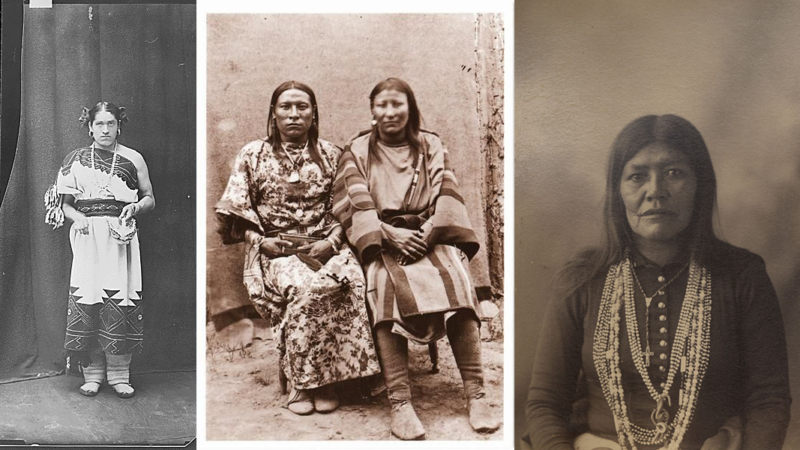
Before contact with European colonizers, Two-Spirit people existed among many Indigenous nations and often held special roles in their communities. There is evidence that in over two-thirds of the 200 Indigenous languages spoken in North America, there were terms used to identify individuals who were neither men nor women. Indigenous views on sexuality were not rooted in heteronormativity. Research and oral histories reflect the widespread respect and honour for Two-Spirit people. Within many Indigenous cultures, the roles of Two-Spirit people carried unique responsibilities that were vital to their communities' well-being and survival.
Some important roles that Two-Spirit people held were as teachers, knowledge keepers, healers, herbalists, childminders, spiritual leaders, interpreters, mediators and artists. The following information intends to illustrate the history and background of how Two-Spirit and gender and sexually diverse Indigenous people have been affected by colonization and how it is unique from the oppressions experienced by other Indigenous peoples. By tracing the relationship between gendered and sexual violence and colonialism, we can start to see how gender and sexuality have been intentionally used by colonizers, settlers, and the Canadian state as a divide-and-conquer tactic, an instrument of gendercide and genocide, as well as an instrument to exert control over Indigenous peoples and lands.
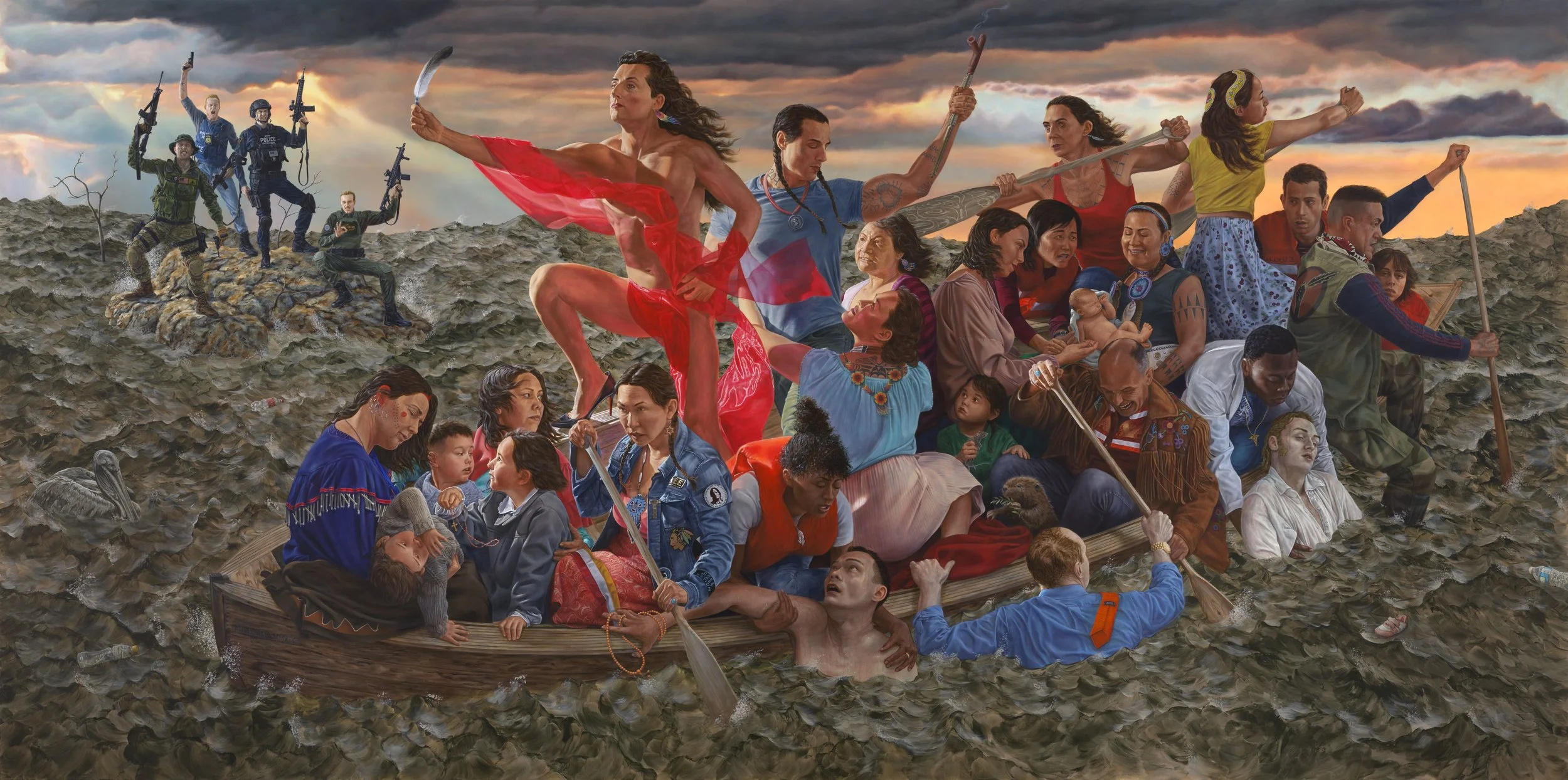
Kent Monkman, mistikôsiwak (Wooden Boat People): Resurgence of the People, 2019. Acrylic on canvas, 132 x 264 in. Collection of the Metropolitan Museum of Art. Image courtesy of the artist.
Historical Timeline
-
Many sources have confirmed that Two-Spirit identities and experiences were honoured and named by Indigenous Peoples before colonization. (C2C, 2019, p. 4) Alex Wilson (she/her), Neyonawak Inniniwak, Opaskwayak Cree Nation, writes about how, “Traditionally, Two-Spirit people were simply a part of the entire community; as we reclaim our identity with this name, we are returning to our communities.” (Wilson, 1996, p. 305)
-
Travel accounts and missionary dictionaries formally introduce the word “berdache”, a misinterpretation of Two-Spirit peoples which has been defined as an, “…effeminate or morphological male who does not fill a society’s standard man’s role, who has a non-masculine character.” (Wilson, 1996, p. 304)
-
John Tanner (he/him) a white American living in the Great Lakes and Red River regions, writes about an encounter with an Ojibwe community member, a person who, “…was one of those who make themselves women (…) They are commonly called A-gokwa…”
(Tanner, 1830, p. 105)
-
Edwin Arthur Watkins (he/him), published ‘A Dictionary of the Cree Language’ lists the word ayākwāo, defining it as, “a castrated animal, a hermaphrodite”. (Watkins, 1865, p. 195)
-
Albert Lacombe (he/him), a French missionary, published ‘Dictionnaire de la langue des Cris’ in which the word ayekkwe is recorded as meaning a person who is castrated, and also neither male nor female.
-
The Basket and the Bow, a 2Spirit gathering was held in Minneapolis, Minnesota, with Canadian participants from Winnipeg in attendance. This gathering established the re-emergence of 2Spirit people in North American history, culture, and decolonization and reconciliation efforts. The annual gatherings have continued to be held in Canada and the US for the past 38 years establishing a network of 2Spirit community leaders, activists, and knowledge keepers.
-
The 2-Spirited People of the 1st Nations (formerly Gays and Lesbians of the First Nations) is founded in Toronto and the organization continues to be an example of community leadership and service delivery.
-
At the 3rd international gathering of North American Native Gays and Lesbians at the Sandy Saulteaux Spiritual Centre north of Winnipeg, Dr. Myra Laramee introduced the name, Two-Spirits” which was quickly adopted by participants from Canada and the US.
-
The Royal Commission on Aboriginal Peoples (RCAP) mentions “homosexuals” in six instances in one volume of its five-volume reports, however there are no specific recommendations regarding “homosexual” Indigenous people in its final analysis.
-
The Canadian Aboriginal AIDS Network (CAAN) is founded as a national AIDS Service Organization (ASO). Its membership is primarily composed of Indigenous ASOs and 2Spirit organizations.
-
Alex Wilson (she/her), Neyonawak Inniniwak, Opaskwayak Cree Nation, described Two-Spirit people as being born ‘in balance’, “…which may be understood as androgyny, a balance of masculine and feminine qualities, of male and female spirits.”
(1996, p. 305)
-
The Assembly of First Nations (AFN) includes a recommendation in its HIV action plan to educate First Nations about the historical and cultural roles of First Nations 2Spirit people.
-
Two-Spirits in Motion, 1st Canadian Forum The 1st Canadian Forum on Two Spirit Peoples, HIV/AIDS, and Health took place in Edmonton, Alberta. This landmark conference created the 2 Spirits in Motion Society. It is the leading national group for Indigenous LGBTQ and Two-Spirit peoples in Canada.
-
Two-Spirited People of Manitoba Inc. (2Spirt Manitoba) is incorporated in Winnipeg. The organization was founded as the Niciwâkan Native Gay Society in 1986 and received funding in January 2021.
-
The Truth and Reconciliation Commission’s (TRC) mandate was to document the history, impacts, and lasting legacy of the Indian Residential School (IRS) system, promoting reconciliation between Indigenous and non-Indigenous peoples. It is estimated that 10% or 15,000 of the 150,000 IRS students were/are 2Spirit. There were attempts to include 2Spirit people at the TRC’s national and regional events as well as in statement gathering. A special consultation, co-sponsored by Egale Canada, with commissioners and 2Spirit leaders was held in Toronto in March 2015. None of the TRC’s 94’s Calls to Action specifically address the dismantling of the binary gender ideology imposed on Indigenous people or the acknowledgment and inclusion of 2Spirit people in all aspects of reconciliation.
-
TRC’s Volume 5 (Canada’s Residential Schools: The Legacy), Chapter 4 (“An Attack on Aboriginal Health: The Marks and the Memories”) discusses Two-Spiritness, describing, “Aboriginal people traditionally celebrated people who were gay or transgender as gifted, as being ‘TwoSpirits’. The residential schools had particular impacts upon TwoSpirited people, who faced numerous attacks on their identities” (TRC, 2015c, p. 148)
-
The Prime Minister, Justin Trudeau, announced that Randy Boissonnault, Member of Parliament for Edmonton Centre, had been named Special Advisor on LGBTQ2 issues. Mr. Boissonnault’s principal role was to advise the Prime Minister on the development and co-ordination of the Government of Canada’s LGBTQ2 agenda. It would work with LGBTQ2 organizations from across the country to promote equality for the LGBTQ2 community, protect the rights of its members, and address discrimination against them – both historical and current. The addition of the numeral 2 in the acronym was the first time in Canadian history that the federal government acknowledged that 2Spirit people existed.
-
The National Inquiry into Missing and Murdered Indigenous Women and Girls (MMIWG) in Canada was established in 2016 with a mandate to investigate and report on the systemic causes of all forms of violence—including sexual violence, abuse, and murder—against Indigenous women, girls, and 2SLGBTQQIA+ people. The inquiry aimed to expose root causes like colonization, racism, and sexism, providing actionable recommendations for safety and justice.
-
In the House of Commons in Ottawa, Prime Minister, Justin Trudeau, delivered an apology to LGBTQ2 Canadians who experienced historical and ongoing injustices in Canada.
After the apology to LGBTQ2 Canadians, Canada endeavored to support 2SLGBTQI+ organizations, groups, and leaders to build capacity to provide support services in urban, rural, on-reserve, northern, and remote communities.
-
The Assembly of First Nations All Chiefs Assembly in Vancouver approved a resolution to create a national 2Spirit organization and network, now known as the 2Spirts in Motion Society (2SiMS).
-
The MMIWG-2SLGBTQQIA+ Working Group is mandated to write a national action plan to address the inquiry report’s thirty-two 2Spirit-specific Calls for Justice. The group met virtually during the COVID-19 pandemic and wrote the report over forty consecutive weeks.
-
As Minister for Women and Gender Equality, Maryam Monsef championed the LGBTQ2 Community Capacity Fund, which invested $20 million to strengthen the infrastructure, operations, and networks of Canadian LGBTQ2 organizations. This historic initiative provided targeted funding for community-led projects advancing equality and inclusion nationwide.
Canada mandates the 2SLGBTQI+ Secretariat to work within Women and Gender Equality Canada (WAGE) to advance rights and equality for sexual and gender-diverse communities.
Minister Catherine Bennett releases Canada’s MMIWG2S National Action Plan and the MMIWG-2SLGBTQQIA+ National Action Plan.
-
2SLGBTQI+ Action Plan - Launched on August 28, 2022, the Federal 2SLGBTQI+ Action Plan (Action Plan) aims at advancing rights and equality for Two-Spirit, lesbian, gay, bisexual, transgender, queer, intersex and additional sexually and gender diverse (2SLGBTQI+) people in Canada.
The federal government officially places the 2S acronym at the front of the LGBTQI+ acronym in its 2SLGBTQI+ Action Plan.
Manitoba’s Team Wreford wins the international competition to design the LGBT Purge Fund’s 2SLGBTQI+ National Monument (Thunderhead) to be in Ottawa. A 2Spirit Healing Circle is included in the monument’s design.