
Introduction
Welcome to the 2SLGBTQQIA+ National Committee website. The committee’s mandate was established in 2020 as Canada prepared to respond to the 231 Calls for Justice in the final report of the national inquiry into Missing and Murdered Indigenous Women and Girls (June 2019).
The MMIWG Inquiry (Missing and Murdered Indigenous Women and Girls) was a Canadian national inquiry launched in 2016 to investigate systemic causes of violence against Indigenous women, girls, and 2SLGBTQQIA+ people, culminating in a 2019 final report, Reclaiming Power and Place, which detailed human rights violations, genocide, and issued 231 Calls for Justice for governments, institutions, and individuals to end the violence, though progress on implementation has been slow.
Key Aspects:
Mandate: To examine and report on the systemic causes of violence and recommend ways to end it, addressing racism, discrimination, and historical injustices.
Process: Conducted community hearings, institutional hearings, and expert panels to gather testimonies from survivors, families, and knowledge keepers.
Findings: Concluded that deliberate and persistent human rights violations are the root cause, identifying the violence as a form of genocide.
Final Report (2019): Included 231 Calls for Justice, emphasizing principles for transformative change and outlining responsibilities for all level of society.
Support: Provided a 24/7 crisis line and family support services.
The 2SLGBTQQIA+ subworking group was facilitated by Sylvia Maracle, who was the Executive Director of the Ontario Federation of Indigenous Friendship Centres (OFIFC) in Toronto at the time. A national advisory committee of 2Spirit leaders was established to write the 2SLGBTQQIA+ National Action Plan that responded to the inquiry report and aligned with Canada’s MMIWG-2S National Action Plan priorities and objectives.
The call for a National Inquiry into Missing and Murdered Indigenous Women and Girls (MMIWG) in Canada was led by a coalition of Indigenous families, advocacy groups, and grassroots organizations, with the Native Women's Association of Canada (NWAC) and the Assembly of First Nations (AFN) at the forefront of the advocacy efforts.
Key proponents and advocates included:
Indigenous Women's Organizations: NWAC (via their Sisters in Spirit initiative), Pauktuutit Inuit Women of Canada, and provincial groups like the Institute for the Advancement of Aboriginal Women.
Advocacy Groups: Amnesty International, BC MMIWG2S+ Coalition, and various Indigenous friendship centres.
Families and Activists: Survivors and families of victims who worked for years to bring national attention to the crisis.
Support Initiatives: Artist Jaime Black through The REDress Project, which increased public awareness.
These working groups were:
the federal working group
the provincial and territorial working group
the urban working group
the 2SLGBTQQIA+ working group
the First Nations working group
the Inuit working group
the Métis working group
the data working group.
Inquiry
The inquiry was formally established by the Canadian government following this sustained pressure from Indigenous organizations and communities.
Check Public Safety Canada and Indigenous Services Canada (ISC) for government responses and initiatives.
January 2020
Crown-Indigenous Relations Minister Carolyn Bennett’s department mandated several subworking groups to start drafting the various sections of the federal MMIWG2S action plan, including a focus on First Nations, Métis, Inuit, data, and urban communities. Partner organizations and governments participated in the working groups that included over 100 Indigenous women as well as members of the 2SLGBTQI+ community.
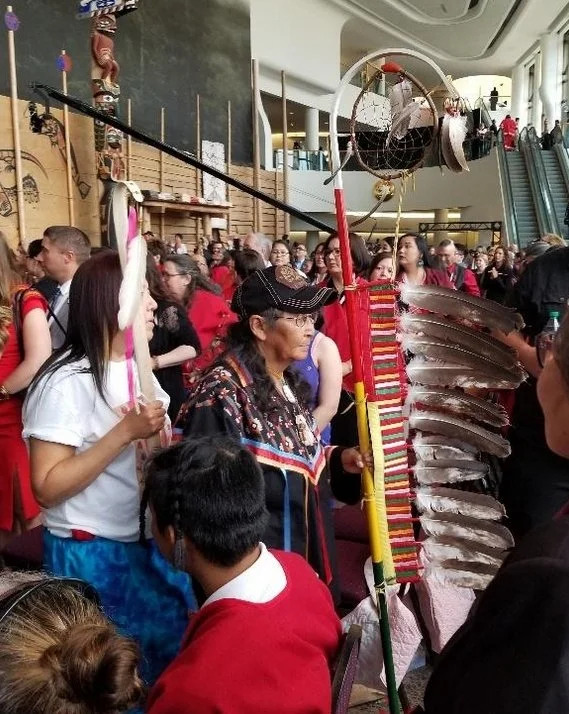
2Spirit Elder, Ma Nee Chacaby, carrying the MMIWG Inquiry eagle staff at the launch of the final report, Gatineau, Quebec, June 2019
Witnesses who testified at the National Inquiry emphasized the need for greater awareness of 2SLGBTQQIA+ issues, including the important history and contemporary place of 2SLGBTQQIA+ people within communities and ceremony, and practical supports and safe places for 2SLGBTQQIA+ people. Several priority areas were identified, including policing, education, justice, socio-economic priorities, health and healing, and child welfare. Witnesses also focused on guiding principles such as self-determined and culturally-specific solutions for 2SLGBTQQIA+ people, respect for human rights, prevention in relation to violence and child welfare, and inclusion of all perspectives in decision making, including youth. Submissions made to the National Inquiry, specific to 2SLGBTQQIA+ peoples, reflected the need for a distinctions-based approach that considers the unique challenges to safety for 2SLGBTQQIA+ individuals and groups, including youth.
Due to COVID-19 pandemic public health restrictions, the 2SLGBTQQIA+ Subworking Group met virtually from January to October 2020 to write the MMIWG-2SLGBTQQIA+ National Action Plan (2021). The subworking group addressed the inquiry’s thirty-two 2SLGBTQQIA+-Specific Calls for Justice.
Funding
Inclusion
Research
Data Collection
Culture
Youth
Grassroots Support
Network
Advocacy
Safer Ceremony
Non-Binary
12. Police Investigation
13. Police Education
14. Sex Industry
15. Precolonial Research
16. Knowledge Keeper Gatherings
17. Re-Educate Communities
18. Competency Training
19. Social Media
20. School Education
21. Incarceration Trans
22. Incarceration
23. Gender Markers
24. Poverty
25. Homelessness
26. Health Services
27. Mental Health
28. Health Centres
29. Care Workers
30. Sex-Reassignment
31. Health Education
32. Child Welfare